

Your cyber insurance renewal is really a security exam. Every year, carriers send a questionnaire asking how your business protects itself, and your answers decide your premium, your coverage and whether you get coverage at all.
At Tech Plus Consulting, cyber insurance audits are one of the most common projects we handle for Oakland and Bay Area businesses. The questions vary a little by carrier, but the same eight show up on almost every form.
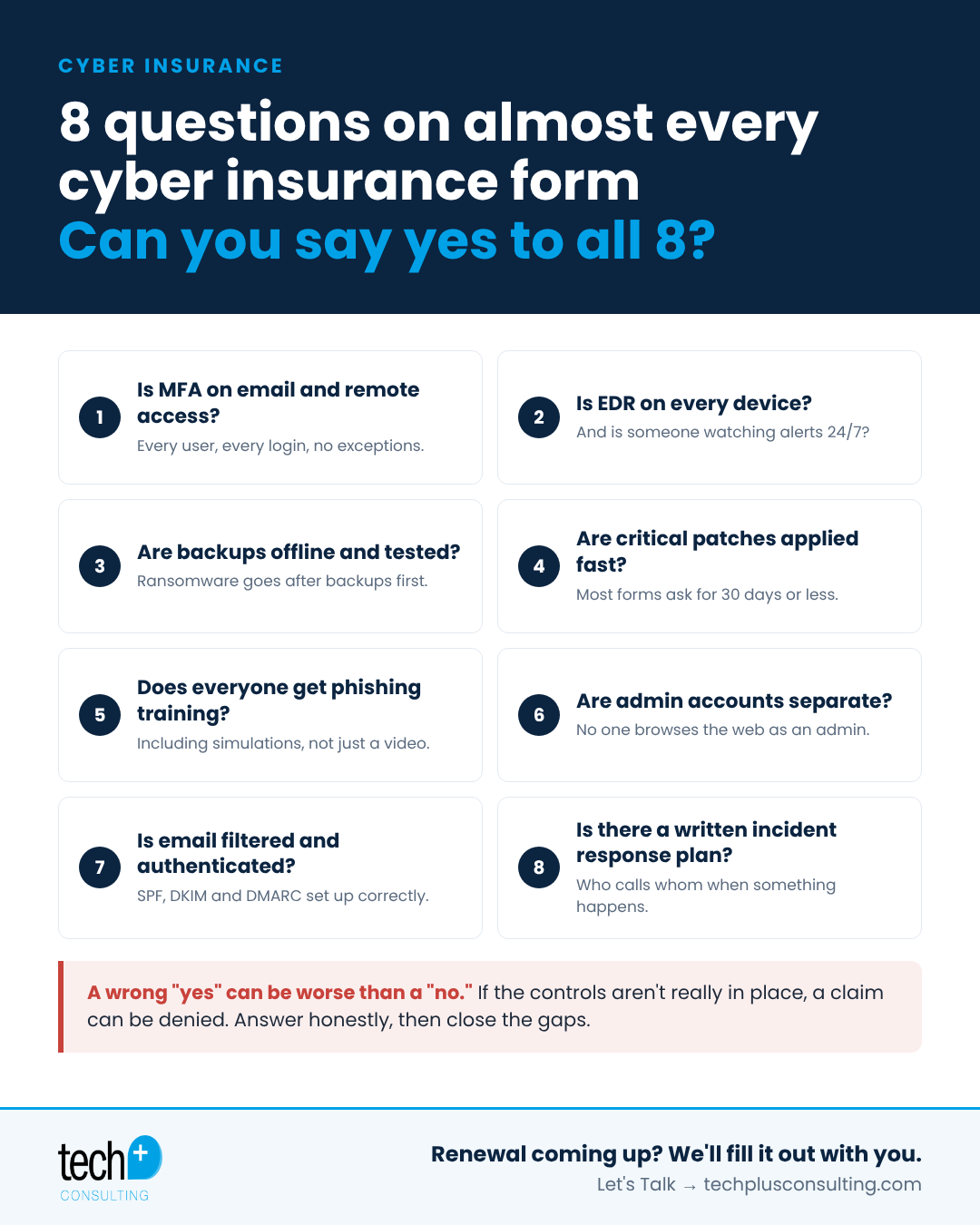
The 8 questions on almost every cyber insurance application
1. Do you require MFA for email, remote access and admin accounts?
Multi-factor authentication is the single most common requirement. Carriers usually want it on email, VPN or remote desktop access, cloud apps and every privileged account.
2. Do you use endpoint detection and response (EDR)?
Traditional antivirus isn't enough anymore. Carriers ask whether every computer and server runs EDR, and increasingly whether it's monitored 24/7 by a security operations center (SOC).
3. Do you keep offline or immutable backups?
Ransomware targets backups first. Carriers want to know your backups are separated from your network, can't be altered, and have actually been tested with a restore.
4. How quickly do you patch critical vulnerabilities?
Expect questions about how often operating systems and software are updated, and whether you track unsupported or end-of-life systems.
5. Do employees receive phishing training?
Most breaches start with an email. Carriers ask whether staff complete security awareness training and phishing simulations, and how often.
6. Are admin accounts separate from everyday accounts?
Using an administrator account to read email and browse the web gives attackers the keys if that account is compromised. Separate, protected admin accounts are now a standard question.
7. Have you set up email authentication (SPF, DKIM and DMARC)?
These DNS records help stop attackers from spoofing your domain in invoice and wire-fraud scams. Carriers check for them, and some scan your domain directly.
8. Do you have a written incident response plan?
If something happens, who do you call and what happens first? A short, documented plan shows carriers you're prepared and speeds up recovery.
The risky part isn't the "no" answers
A "no" might raise your premium. A "yes" that isn't quite true is worse. If you claim MFA is on every account and a breach comes through one that wasn't covered, the carrier can deny the claim. Read every question carefully, answer honestly and close the gaps before you sign.
How to prepare for your renewal
Get the questionnaire early, at least 60 days before renewal
Have your IT provider review each question against what's actually in place
Fix the quick wins first: MFA, email authentication and admin account separation
Document your policies so you can back up every "yes"
Keep a copy of your answers for next year's renewal
Frequently asked questions
Can I fill out the cyber insurance questionnaire myself?
You can, but many questions are technical. Having your IT team review it helps avoid inaccurate answers that could put a future claim at risk.
What happens if we can't answer yes to everything?
You may still get coverage with a higher premium or exclusions. Many gaps can be closed in a few weeks, so it's worth starting early.
Does this help with security beyond insurance?
Yes. These eight controls are the same ones that stop most real-world attacks on small businesses.
Renewal coming up?
Tech Plus fills out the questionnaire with you, puts the missing controls in place and writes the policies to back them up. Learn more about our managed security services in Oakland and the Bay Area. Let's Talk →
